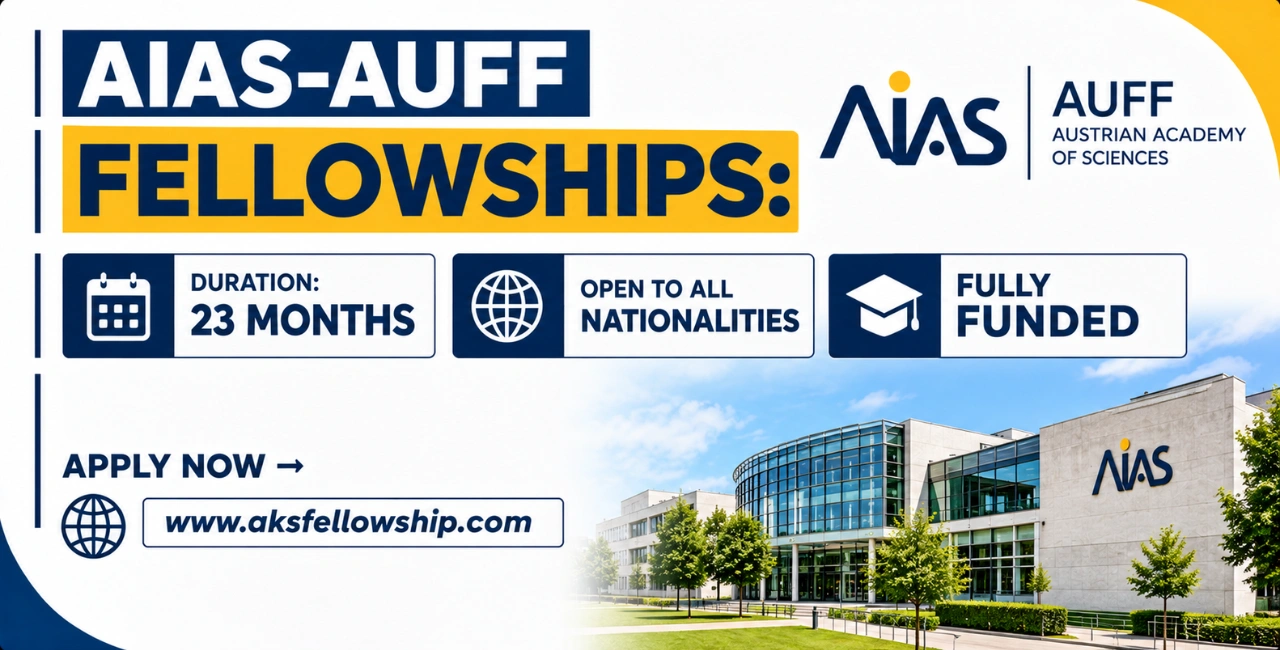
Most research fellowships give you a stipend and a desk. This one gives you a salary. The Aarhus Institute of Advanced Studies AIAS at Aarhus University in Denmark has opened applications for the AIAS-AUFF Fellowships 2027–2029.
Up to ten positions are available. They are open to researchers from every academic discipline and every nationality. Successful fellows are employed under Danish collective union agreements, meaning they receive a proper salary based on seniority not a fixed bursary.
Published on: September 9, 2026. Application window opens August 2026. Deadline confirmed as 3 November 2026 at 12:00 noon CET. Fellows notified March 2027. Program begins 1 September 2027.
At a Glance
| Detail | Information |
|---|---|
| Fellowship | AIAS-AUFF Fellowships 2027–2029 |
| Host | Aarhus Institute of Advanced Studies Denmark |
| Positions available | Up to 10 |
| Duration | 23 months |
| Start date | 1 September 2027 |
| Who can apply | All nationalities |
| PhD requirement | Completed 2 to 10 years before deadline |
| Compensation | Salary under Danish collective agreement |
| Relocation | Travel costs and assistance covered |
| Applications open | August 2026 |
| Deadline | 3 November 2026 |
What This Fellowship Actually Offers
Twenty-three months with no teaching load. No administrative responsibilities. No obligation to supervise students unless you choose to. Just your research your ideas and the time and resources to develop them properly.
That is the core of what AIAS is offering. For academics who have spent years juggling research with everything else a university career demands it is a genuinely compelling proposition.
The financial package is stronger than most fellowship listings make it sound. Compensation is set according to Danish collective union agreements, which means the salary scales with your seniority level.
Denmark consistently ranks among the highest-paying countries in Europe for academic researchers. This is not a modest living allowance. It is employment.
The full package includes:
- Salaried employment under Danish collective agreements
- Relocation travel cost coverage
- Relocation assistance on arrival
- Dedicated office space at AIAS
- Access to academic training programs
- Conference and workshop funding
- Affiliation with Aarhus University research environments
- Access to an international academic network
Relocation support for fellows moving to Denmark is included. A practical detail that makes a real difference for international researchers weighing the logistics of a two year move.
Who Is This Fellowship Actually For
The PhD window matters here and it is worth reading carefully.
- Eligible applicants must have completed their PhD no fewer than two years and no more than ten years before the application deadline of 3 November 2026.
- Researchers who finished very recently and those who are well into mid career are both outside the window.
- Beyond that timing requirement, the fellowship is intentionally broad. Any nationality. Any academic discipline.
- The institute actively welcomes researchers from the sciences, humanities, social sciences, engineering, medicine and everything in between.
To be eligible applicants must:
- Hold a PhD completed between 2 and 10 years before the deadline
- Propose a research project showing originality and academic quality
- Demonstrate interest in interdisciplinary research and collaboration
- Identify meaningful collaboration opportunities at Aarhus University
- Meet the mobility requirement
The Mobility Requirement
This is the eligibility condition most applicants overlook and it is a hard filter.
Candidates must not have resided in Denmark or carried out their main work activity in Denmark for more than 12 months during the two years immediately before the application deadline.
Researchers currently based in Denmark or who have recently completed a Danish postdoc or research position should check this requirement carefully before investing time in an application.
For the majority of international applicants based elsewhere in Europe, Asia, Africa, the Americas or Oceania this requirement will not be a barrier. But it is worth confirming your situation against the specific wording in the official Guide for Applicants before starting.
Timeline at a Glance
| Stage | Date |
|---|---|
| Applications open | August 2026 |
| Application deadline | 3 November 2026 noon CET |
| Evaluation period | November 2026 to February 2027 |
| Applicants notified | March 2027 |
| Fellowship begins | 1 September 2027 |
The evaluation window runs for approximately three months. Plan accordingly. This is not a program that announces results quickly after the deadline closes.
Applying Through GrantOne Practical Details
Applications are submitted through the GrantOne online portal. Before opening the form, download and read the official Guide for Applicants. This is not a document to skim. It contains the specific application structure the evaluation criteria and what reviewers are actually looking for in each section.
A strong application typically demonstrates three things:
- The originality and quality of the proposed research
- The applicant’s capacity to work independently at this career stage
- A credible specific connection to researchers or research environments at Aarhus University
That third element the Aarhus collaboration component, is where many applications underperform. Naming a department or a general research area is not enough. Identifying a specific faculty member whose work connects meaningfully to yours and explaining how that connection could develop during the fellowship makes the application substantially more credible.
One practical warning for international applicants:
The deadline is 12:00 noon CET on 3 November 2026, not midnight. Applicants in time zones significantly ahead of or behind Central European Time should calculate their local submission deadline carefully. Missing a noon deadline because you assumed it was an end of day cutoff is an avoidable reason to lose an application.
Submit at least 24 to 48 hours early. Technical issues with online portals close to deadlines are common enough that building in that buffer is standard practice for competitive fellowship applications.