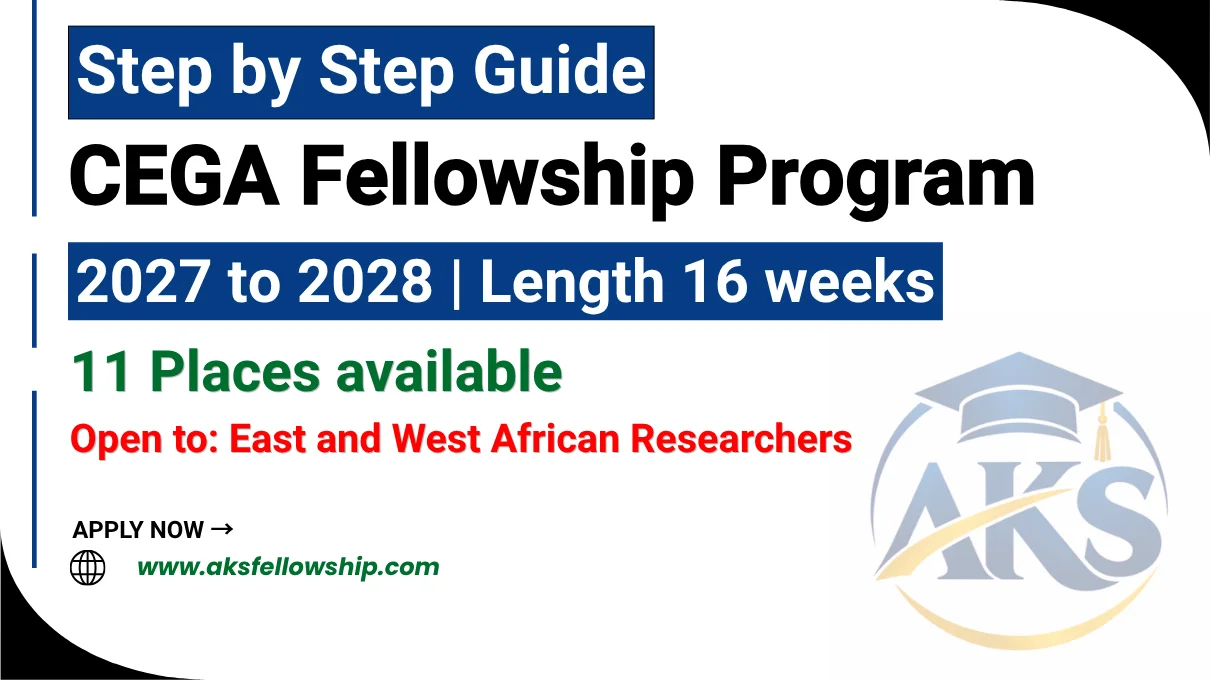
This fellowship gives you a choice many programmes do not. You can join in person at UC Berkeley or online from home. Both options last 16 weeks.
The Center for Effective Global Action (CEGA) at the University of California Berkeley runs it. It is for African researchers and development practitioners who want to learn impact evaluation and quantitative development research. Two tracks are open. The Practitioner Track is for people in government ministries and NGOs and think tanks. The Academic Track is for early career scholars.
Applications close on Sunday 17 January 2027 at 5:00 pm GMT. That is 6:00 pm in Lagos and 8:00 pm in Nairobi. CEGA plans to select 11 fellows. Your eligibility depends on your country so check that first.
Last Information Checked: 4 November 2026
At a Glance
| Item | Details |
| Programme | CEGA Fellowship Program 2027 to 2028 |
| Host | Center for Effective Global Action (CEGA) at UC Berkeley |
| Run through | CEGA Global Networks |
| Length | 16 weeks |
| Periods | Fall 2027 (August to December) or Spring 2028 (January to May) |
| Formats | Resident (in person at UC Berkeley) or Non Resident (online) |
| Tracks | Practitioner Track (7 planned fellows) and Academic Track (4 planned fellows) |
| Who can apply | Researchers and practitioners from East and West Africa |
| Qualification | Master’s degree or current PhD student or PhD finished within 8 years |
| Language | Fluent English |
| Application fee | Not stated |
| Deadline | Sunday 17 January 2027 at 5:00 pm GMT |
About the CEGA Fellowship
CEGA is based at the University of California, Berkeley. The fellowship sits inside its Global Networks programme. This programme supports research that guides economic development policy in East and West Africa.
Fellows audit coursework and build skills in quantitative development research. They follow a personal mentorship programme to develop their research ideas. They also build networks with other researchers. Each fellow also gets a faculty mentor and a PhD peer partner.
The programme welcomes many development topics:
- Agriculture and food security
- Financial inclusion and economic empowerment
- Gender equality and social development
- Technology for development
- Energy and climate change
- Economic development and public policy
- Public health and related social sciences
After the programme alumni stay connected through the Network of Impact Evaluation Researchers in Africa (NIERA). CEGA also runs a separate Global Networks research grant competition. It funds teams that include at least one CEGA fellow. The 2026 round offers up to 67000 US dollars for each project.
Also See: Anthropic Residency 2027: Paid AI Research Placements | Salary $35,0000 to $ 500,000
Two Tracks for African Applicants
You choose one preferred track in your application.
Practitioner Track
This track is for professionals who want better research skills to grow into senior roles. You should work for an NGO or think tank or government ministry in East or West Africa. You should be actively using or promoting evidence to improve economic and social well being. CEGA plans to select seven fellows here. You submit a policy statement of two pages at most.
Academic Track
This track is for early career scholars who want an academic career. You should be a doctoral student or hold a staff position at a university or research institution. A place that supports policy relevant quantitative social science is preferred. You should be ready to develop your own research proposal or join a faculty member’s existing project. CEGA plans to select four fellows here. You submit a research proposal of two pages at most.
Resident and Non Resident Formats
| Item | Resident Fellow | Non Resident Fellow |
| Where | In person at UC Berkeley | Online |
| Length | 16 weeks | 16 weeks |
| Time needed | 40 hours a week | About 15 to 20 hours a week |
| Period | Fall 2027 or Spring 2028 | Fall 2027 or Spring 2028 |
| Country rule | Must be from a J-1 eligible country (list below) | Priority for countries under US visa limits (list below) |
Fellowship Benefits
Resident Fellows
- Round trip international flights
- Accommodation at International House at UC Berkeley
- Meals during the fellowship
- Visa fees
- Health insurance
- A stipend for other expenses
Non Resident Fellows
- A stipend for other expenses
- The chance to take part from your home country or institution
Both formats
- Audited coursework in quantitative development research
- A faculty mentor and a PhD peer partner
- Help to develop your research ideas
- Membership in the CEGA fellows network and NIERA
Who Can Apply
For both tracks you must:
- Be fluent in written and spoken English and be a strong communicator
- Be from an East African or West African country
- Have finished at least secondary school in an African institution
- Hold at least a Master’s degree or be enrolled in a PhD or have finished a PhD within the past 8 years
- Have a background in economics or political science or statistics or epidemiology and public health or another social science
- Plan to return to an institution in East or West Africa after the fellowship
If you are doing a PhD outside Africa you may finish it before you return. Women are particularly encouraged to apply.
Resident Fellows must be from a country that is eligible for a J-1 visa under current US rules:
Djibouti | Ethiopia | Ghana | Guinea | Guinea-Bissau | Kenya | Liberia | Madagascar | Mauritius | Mozambique | Rwanda | Seychelles | Uganda
This list can change with US regulations.
Non Resident Fellows are prioritised from countries now under US visa limits:
Benin | Burkina Faso | Burundi | Côte d’Ivoire | The Gambia | Malawi | Mali | Mauritania | Niger | Nigeria | Senegal | Sierra Leone | Tanzania | Togo | Zambia | Zimbabwe
Required Documents
- Personal statement: One page at most. Explain your motivation and goals and why you chose CEGA and how you will commit to the fellowship.
- CV: Two pages at most. Show your qualifications and work and quantitative coursework.
- Policy statement: Practitioner Track only. Two pages at most. Use the CEGA template.
- Research proposal: Academic Track only. Two pages at most. Use the CEGA template.
- Two professional references: Give names and emails and phone numbers and institutions.
- Leave or support letter: From your supervisor or department chair. Resident Fellows must show approval for 40 hours a week. Non Resident Fellows must show approval for 15 to 20 hours a week. Both cover four months.
- Optional: One working paper or publication
How To Apply
- Read the CEGA Request for Applications and the guidelines on the official CEGA application portal.
- Choose your track and your format. Also choose Fall 2027 or Spring 2028.
- Join the information webinar on 2 December 2026.
- Start your leave letter and your two references now. They depend on other people.
- Write your personal statement and your policy statement or research proposal using the CEGA templates.
- Submit everything through the portal before 17 January 2027 at 5:00 pm GMT.
CEGA says applications should not be written entirely with generative AI. It wants your own thinking and clear research questions and realistic goals. Send questions to global-networks-cega@berkeley.edu.
Key Dates
- 2 December 2026 at 7:00 pm East African Time: Information webinar (4:00 pm GMT)
- Sunday 17 January 2027 at 5:00 pm GMT: Application deadline
- August to December 2027: Fall fellowship period
- January to May 2028: Spring fellowship period
- Decision date: not stated