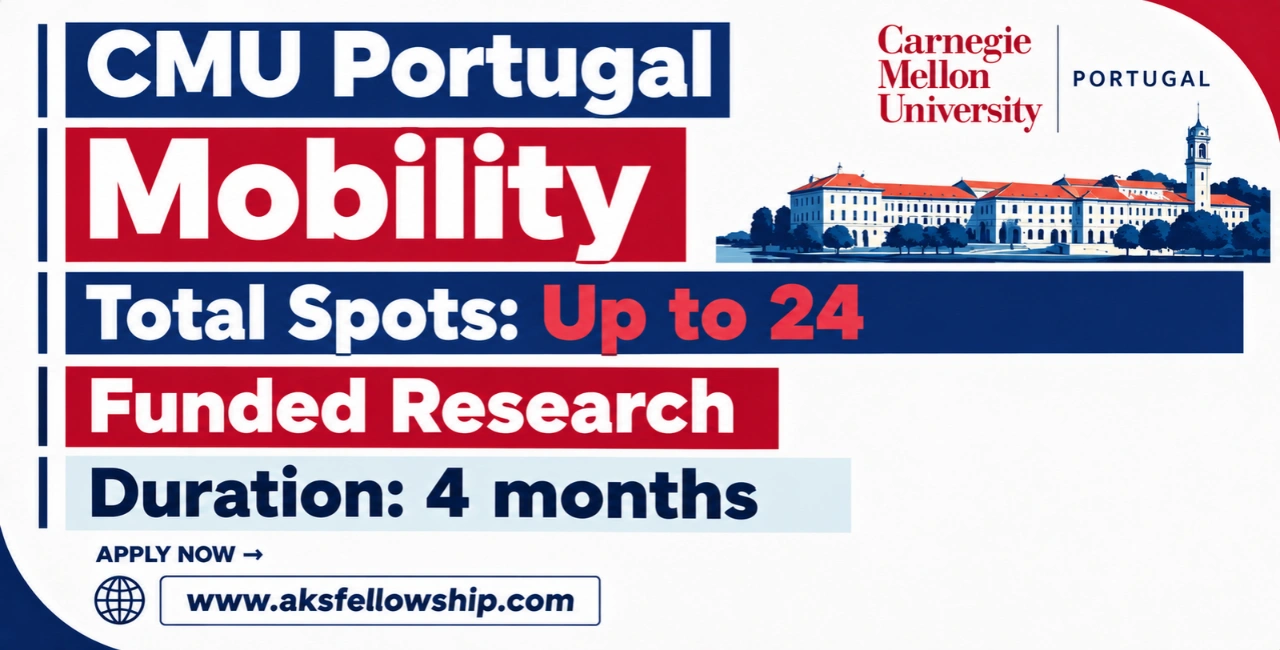
If you study or research in tech in Portugal, there is a partnership working quietly in the background that could get you a research stint at one of the top computer science universities in the world. Applications for the CMU Portugal mobility calls just opened.
Up to 24 people will get funded visits to Carnegie Mellon University in Pittsburgh next year. Here is who qualifies and how the process actually works.
At a Glance
| Detail | Information |
|---|---|
| Programme | CMU Portugal Mobility 2027 |
| Host | Carnegie Mellon University Pittsburgh USA |
| Total spots | Up to 24 |
| Tracks | Visiting Faculty and Researchers up to 10 Visiting Students up to 14 |
| Duration | 2 weeks to 4 months |
| Focus | ICT research, education, innovation |
| Eligibility base | Portuguese citizens or permanent residents |
| Deadline | 15 November 2026 |
What CMU Portugal Actually Is
This is not a one-off scholarship. It is a long-running partnership between Portugal’s Fundação para a Ciência e Tecnologia FCT and Carnegie Mellon University built specifically to strengthen ties between Portuguese research institutions and CMU.
The mobility initiative has existed in different forms for almost two decades. The faculty exchange side traces back to 2007 and has already supported 107 visits to CMU. The student side began in 2014 as an internship program and has sent 88 students to Pittsburgh so far.
The 2027 round continues that track record, offering visits ranging from two weeks up to four months depending on the program and the approved research plan.
Two Separate Tracks, Two Different Audiences
CMU Portugal splits this opportunity into two distinct programs. It matters which one you fall under because the eligibility rules are not identical.
Track 1: Visiting Faculty and Researchers Program
This track offers up to 10 grants for established academics.
To qualify you need to:
- Be a Portuguese citizen or a foreign citizen with permanent residence in Portugal
- Hold a doctoral degree already at the time of application
- Be affiliated with a Portuguese higher education institution or research laboratory
- Work in a field connected to ICT research, education or innovation
This is aimed at people who already have an academic base in Portugal and want to build a real working relationship with CMU colleagues, not just attend a short conference. Given that the faculty exchange side of this program has run since 2007 there is a genuine track record of these visits leading to longer-term collaborations.
Track 2: Visiting Students Program
This track offers up to 14 spots for master’s students and recent graduates.
To qualify you need to:
- Be a Portuguese citizen or permanent resident of Portugal
- Be currently studying or have completed a master’s degree in an ICT-related field
- If you are a recent graduate rather than a current student, your degree must have been awarded in Portugal within the last five years
This track is built for hands-on research exposure. You work directly with CMU faculty inside their research environment rather than sitting in on lectures. For a master’s student trying to decide whether a PhD abroad makes sense, this kind of short structured exposure can be genuinely useful before committing to years of study elsewhere.
What You Actually Get
Regardless of which track you apply under the core opportunity is the same. An approved research period at Carnegie Mellon University in Pittsburgh lasting between two weeks and four months.
During that time participants get:
- Direct collaboration with CMU faculty and researchers
- Real exposure to CMU’s research and innovation environment in ICT
- The chance to build an international academic or professional network
- For students, specifically hands-on research experience rather than passive learning
This is not a tourist-style academic exchange. The structure is built around actual research collaboration, which is a meaningful distinction if you are trying to build a CV that stands out in ICT research circles.
Why ICT Specifically
Both tracks are locked to information and communication technologies. That is intentional. CMU is globally known for its computer science and engineering programs and the entire CMU Portugal partnership exists to connect Portuguese ICT talent with that specific strength.
If your work sits outside ICT, or in even loosely related fields, this program likely is not the right fit. It is worth confirming your research area aligns before investing time in an application.
Key Dates to Track
- Applications open 15 September 2026
- Online information session 7 October 2026
- Application deadline 15 November 2026
- Visits take place throughout 2027
The information session is worth attending if you are on the fence about applying. It is a live opportunity to ask about the application process directly rather than guessing at requirements from written guidance alone.
How to Apply
Because eligibility differs by track read the requirements for your specific program carefully rather than assuming general ICT experience is enough. The faculty track requires a completed doctorate. The student track does not but it has its own graduation-date limits for recent graduates.
Applications go through the CMU Portugal Admissions and Scholarships page and questions can be sent directly to apply@cmuportugal.org.
Why This Matters Beyond the Individual Applicant
Programs like this rarely make headlines but they quietly shape where research talent flows. For Portugal, sending researchers and students to CMU builds long-term academic relationships that outlast any single visit. For the individuals involved, two weeks to four months at a university like CMU can open doors that a standard academic CV line cannot.
If you are a Portuguese researcher, faculty member, master’s student or recent graduate working in ICT, this is a concrete funded route into one of the strongest tech research environments in the world. With only 24 spots available across both tracks, a clear, well-prepared application matters more than a rushed one. Start reviewing the official eligibility details now and aim to submit well ahead of the 15 November 2026 deadline.