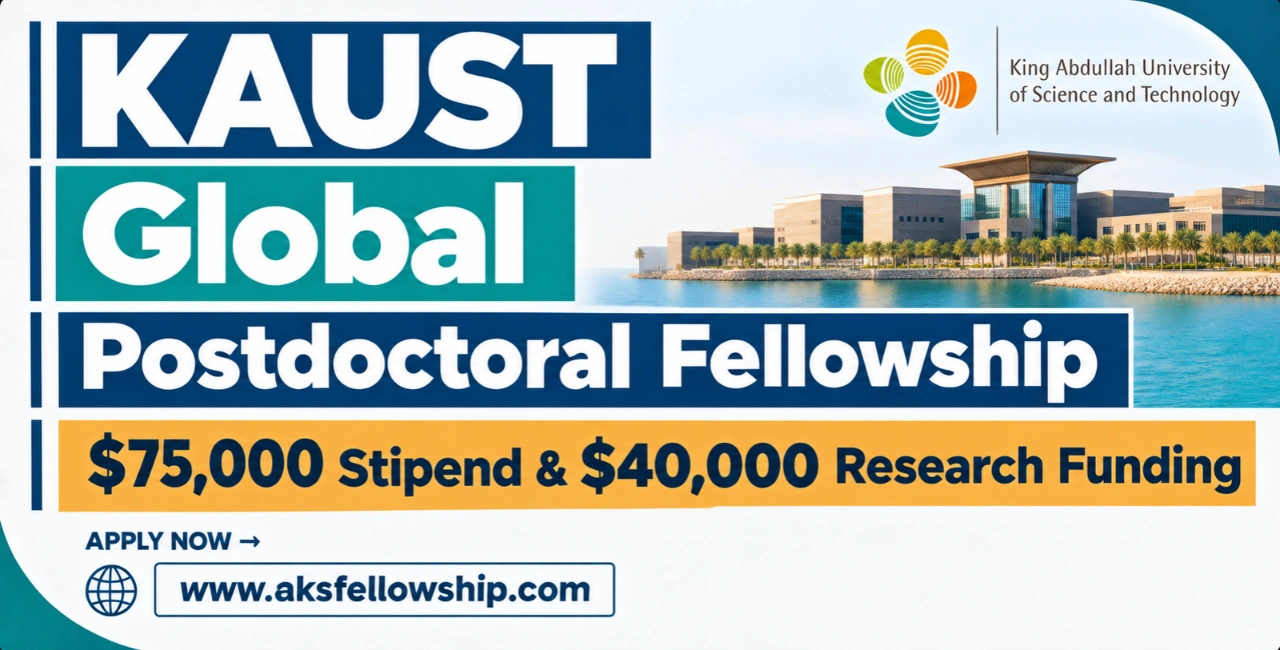
Most postdoctoral positions follow a familiar pattern. You join someone else’s lab, work on someone else’s research agenda and you spend a few years building their vision before you get a real shot at your own. The KAUST Global Postdoctoral Fellowship skips that step entirely. You design and lead your own project from day one.
That single difference changes what this opportunity actually is. It is not just a well-paid postdoc. It is a head start on becoming an independent researcher three years earlier than the traditional academic path usually allows.
At a Glance
| Detail | Information |
|---|---|
| Fellowship | KAUST Global Postdoctoral Fellowship |
| Host | King Abdullah University of Science and Technology Saudi Arabia |
| Location | Thuwal Saudi Arabia |
| Duration | 3 years |
| Annual stipend | US$75000 |
| Research funding | Up to US$40000 |
| Project ownership | Fellow-led with host PI support |
| Stage 1 deadline | 1 October 2026 |
| Full proposal deadline | 15 January 2027 by invitation |
| Open to | Any nationality PhD after January 2023 |
What Makes This Fellowship Different
King Abdullah University of Science and Technology, based in Thuwal, Saudi Arabia is offering this fellowship to early-career scientists and engineers from anywhere in the world. The structure is what sets it apart.
You still work alongside a host Principal Investigator at KAUST, someone whose lab and expertise support your work. But you keep intellectual ownership of your project. This is not you helping someone else’s research along. It is your research with KAUST’s resources and mentorship behind it.
This matters for anyone thinking about their next career step after a PhD. A fellowship where you build your own research identity rather than extending someone else’s tends to translate into a much stronger case when you are later applying for faculty positions.
The Money Broken Down
This is one of the more generous postdoctoral packages available anywhere right now. Fellows receive:
- US$75000 annual living stipend
- Up to US$40000 in dedicated research funding for their project
- Three full years of funded support
- Comprehensive medical insurance
- On-campus accommodation
- Schooling support for up to three children
- A relocation allowance
- Annual travel assistance for conferences and collaboration
- Access to KAUST’s research labs and infrastructure
What KAUST Actually Wants You to Research
Your proposed project needs to connect to at least one of KAUST’s strategic research missions:
- Water
- Food
- Health
- Energy
- Artificial Intelligence
- The Red Sea
These are not arbitrary categories. They tie directly into Saudi Arabia’s Vision 2030 strategy which is pushing the country toward economic diversification and major investment in science and technology. Your research also needs to fit within one of KAUST’s academic divisions covering areas from biological and environmental sciences to computer and electrical engineering to physical sciences.
If your work sits outside these six mission areas entirely, this fellowship likely is not the right fit regardless of how strong your research is otherwise.
Who Can Apply
Eligibility is open to researchers of any nationality. KAUST specifically encourages applications from women aiming to improve gender balance across science and engineering fields.
The core requirements are:
- A PhD awarded after January 2023 for this 2027 call or an expectation of completing your PhD before the fellowship starts
- Willingness to relocate to Thuwal, Saudi Arabia
- Identification of one to three KAUST faculty members whose work aligns with your proposed research
- Meeting Saudi Arabia’s residency requirements before the fellowship begins
The Two-Stage Application Process
This fellowship does not ask for a full proposal upfront. It filters candidates in two distinct stages.
Stage 1: Concept Note
Open from 1 September to 1 October 2026, this stage asks for a shorter concept note outlining your proposed research. You do not need a formal support letter from a host PI yet but you do need to identify up to three relevant KAUST faculty members in your application.
Required documents for this stage:
- A CV with full publication list, maximum four pages
- Up to two selected publications
- A concept note using KAUST’s official template
- Two reference letters either uploaded or sent directly by referees via email
Stage 2: Full Proposal
Only applicants who receive support from a KAUST faculty member move forward to this stage. Full proposals are submitted between 15 November 2026 and 15 January 2027.
This structure means your Stage 1 concept note is not just a formality. It is the actual filter. If a faculty member does not back your proposal after Stage 1, you do not advance regardless of how strong your CV looks on paper. This makes identifying the right faculty connection early one of the most important parts of your strategy.
Apply Now for KAUST Global Postdoctoral Fellowship
How to Make Your Application Competitive
Since faculty support drives advancement to Stage 2, your concept note needs to do real work. It should align clearly with one of KAUST’s six research missions and it should make an obvious case for why a specific KAUST faculty member’s expertise complements what you want to do.
Beyond that alignment, KAUST is looking for:
- A strong publication record
- Genuine interdisciplinary research experience
- A clear well-defined path toward research that has real-world impact not just academic interest
The fellowship explicitly values ideas that can contribute to both scientific knowledge and broader societal or economic development. A concept note that only demonstrates technical skill without a clear sense of why the work matters beyond the lab is likely to be a weaker candidate here.
Key Dates to Track
| Milestone | Date |
|---|---|
| Call opens | 1 September 2026 |
| Stage 1 deadline | 1 October 2026 |
| Full proposal opens | 15 November 2026 |
| Full proposal deadline | 15 January 2027 |
| Fellowship duration | 3 years |
Notice the gap between Stage 1 closing and Stage 2 opening. There is roughly six weeks between the concept note deadline and when full proposals open which is when faculty are reviewing submissions and deciding who to support. Use that window to keep building your case with prospective host faculty rather than assuming the process is entirely out of your hands once you submit.
Why This Fellowship Is Worth Serious Consideration
For early-career researchers weighing their next step after a PhD the usual trade-off is between funding and independence. Well-funded postdocs often come with less freedom to set your own agenda. Independent fellowships elsewhere sometimes come with far smaller budgets.
KAUST is offering both at once. A genuinely substantial financial package alongside real ownership over your research direction three years earlier in your career than most paths allow. Combined with access to a campus bringing together researchers from more than 110 nationalities, this is a rare combination of resources and independence.
If your research connects to water, food, health, energy, AI or the Red Sea, and you completed your PhD after January 2023 this deserves a serious look. Start identifying potential KAUST faculty collaborators now, since that relationship matters well before the 1 October 2026 Stage 1 deadline.