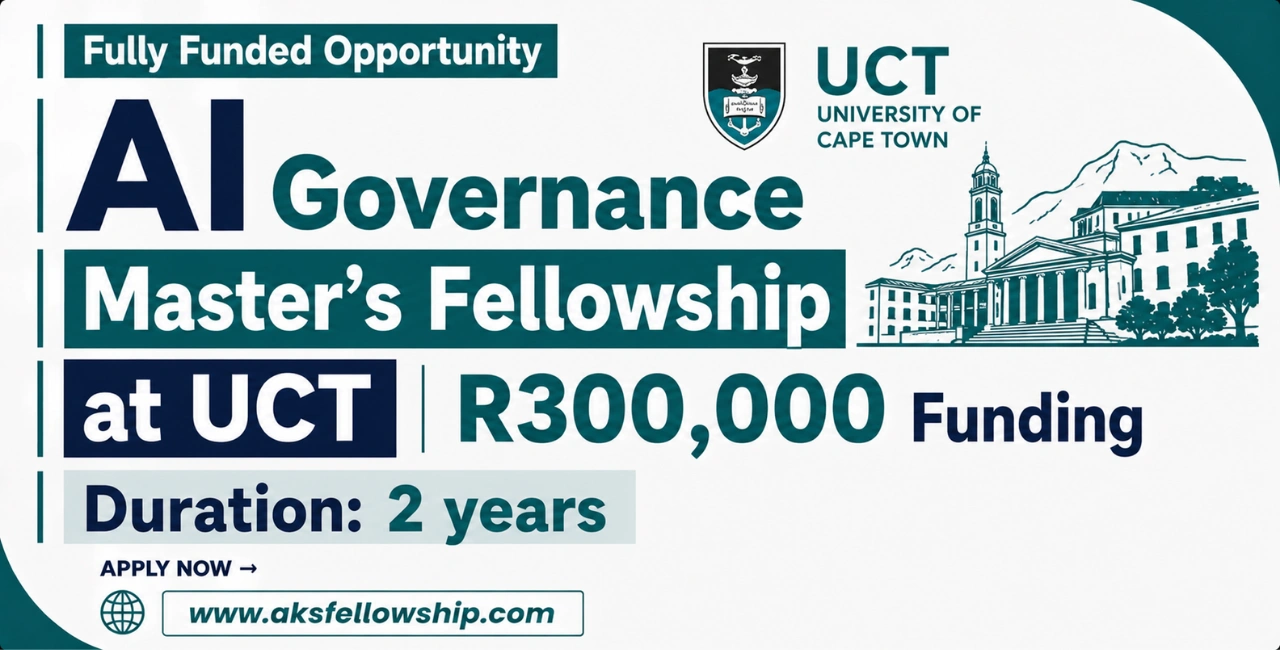
The African Hub on AI Safety, Peace and Security under the Artificial Intelligence for Development Programme is offering a Master’s Fellowship in AI Governance and Harm Mapping. The AI Governance Master’s Fellowship supports an emerging African researcher to study how artificial intelligence related harms are experienced across African contexts and to identify governance gaps that leave these risks insufficiently addressed.
The selected student will receive funding of approximately R150000 per year for two years. Total support is around R300000. The research will be supervised by Dr Annette Hübschle and Professor Jonathan Shock at the University of Cape Town.
At a Glance
| Detail | Information |
|---|---|
| Fellowship | Master’s Fellowship in AI Governance and Harm Mapping |
| Host | African Hub on AI Safety Peace and Security AI4D Programme |
| University | University of Cape Town |
| Duration | Two years |
| Funding | Approximately R150000 per year, total around R300000 |
| Focus | AI related harms and governance gaps in African contexts |
| Supervision | Dr Annette Hübschle and Professor Jonathan Shock |
| Application | Rolling until filled |
Research Focus
Artificial intelligence is increasingly shaping societies, economies, governments and public services. While AI can create opportunities, its development and use can also produce or reinforce different forms of harm.
The selected student will investigate how AI related harms appear across Africa. The research will also explore governance and regulatory gaps that may allow these harms to remain unaddressed.
The work draws on harmscapes thinking. This approach views harm as layered, interconnected and structural rather than as isolated incidents. It helps examine how technological risks interact with institutions inequalities and social conditions.
The research aims to contribute to a scalable AI safety risk framework suitable for resource constrained African settings.
What Is Harmscapes Thinking
Harmscapes thinking treats AI related risks as part of a broader landscape. Some harms may be immediately visible. Others may develop gradually through systems, policies, institutional practices or unequal access to resources.
The fellowship encourages the researcher to explore these interconnected dimensions. The goal is to identify patterns and governance gaps that might otherwise be overlooked.
This approach is relevant because AI technologies evolve quickly while regulatory frameworks often struggle to keep pace. Findings could inform AI safety risk governance, regulatory analysis and responsible technology development in African contexts.
About the Host
The fellowship is based at the African Hub on AI Safety, Peace and Security which forms part of the Artificial Intelligence for Development Programme.
The hub provides a research environment for examining links between AI technologies and questions of governance, safety, peace and security affecting African societies.
The selected student will focus on a rapidly growing research area while contributing to discussions on how AI governance frameworks can better reflect African realities.
Who Should Apply
The fellowship is open to candidates with an Honours degree or equivalent qualification in a relevant discipline.
Suitable backgrounds include:
- Law
- Governance
- Public policy
- Criminology
- International relations
- Related social science disciplines
Applicants should show strong interest in:
- AI governance
- Artificial intelligence policy
- Regulatory analysis
- Technology governance
- AI safety
- Risk analysis
- Structural approaches to harm
- Harm based approaches to risk
- Public policy and emerging technologies
Candidates also need strong analytical, communication and organisational skills. The ability to connect technology questions with law, governance, society policy and risk is especially useful.
Funding Support
The successful candidate will receive approximately R150000 per year for two years. Total support is around R300000.
The funding is intended to contribute towards:
- Tuition costs
- Living expenses
- Research related activities
Prospective applicants should review the full call for details on how the funding is administered and any conditions attached.
Supervision
The Master’s research will be supervised by Dr Annette Hübschle and Professor Jonathan Shock at the University of Cape Town.
The student will work in an interdisciplinary environment addressing questions related to AI risk governance, safety and African development.
Encouragement for African Applicants
Applications are particularly encouraged from South African and other African nationals. The call also places emphasis on candidates from previously disadvantaged groups.
This focus helps ensure that research and policy discussions on AI safety and governance include perspectives rooted in the communities and contexts where these technologies are being developed and used.
How to Apply for AI Governance Master’s Fellowship
Interested applicants should carefully review the full call for applications. Check eligibility requirements, funding arrangements, research expectations and the application process.
Candidates should meet the academic requirements and demonstrate clear interest in AI governance, regulatory analysis or structural and harm based approaches to risk.
Applications are considered on a rolling basis until the position is filled. Eligible candidates are strongly encouraged to submit as early as possible.
Key Takeaways
- Two year Master’s Fellowship focused on AI harms and governance gaps in African contexts
- Funding of approximately R150000 per year, total around R300000
- Based at the African Hub on AI Safety, Peace and Security under the AI4D Programme
- Supervised at the University of Cape Town by Dr Annette Hübschle and Professor Jonathan Shock
- Uses harmscapes thinking to examine layered and structural risks
- Open to candidates with an Honours degree or equivalent in relevant social science or related fields
- Strong encouragement for South African and other African nationals especially from previously disadvantaged groups
- Applications reviewed on a rolling basis until filled so apply early