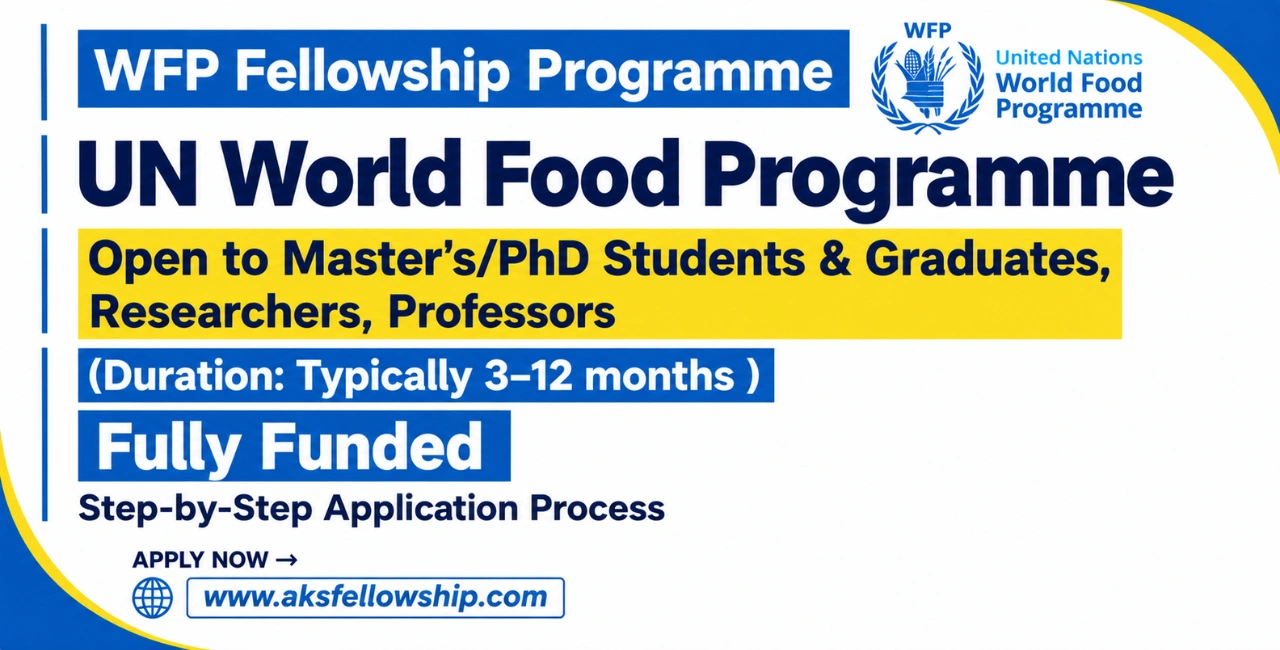
Researchers often produce rigorous work that never reaches the people designing food-assistance programmes or responding to crises. The World Food Programme’s Fellowship Programme and academic partnerships exist to close that gap.
Master’s students, doctoral researchers, postdoctoral fellows, professors and other academics can contribute evidence and ideas directly to WFP’s work on hunger, food security, resilience and humanitarian operations — while gaining practical exposure inside a major UN organisation.
WFP Fellowship Programme Overview
| Detail | Information |
|---|---|
| Programme | WFP Fellowship Programme (part of academic partnerships) |
| Host | United Nations World Food Programme (WFP) |
| Who can apply | Master’s/PhD students & graduates, researchers, professors |
| Duration | Typically 3–12 months (assignment-dependent) |
| Locations | Headquarters, regional bureaux or country offices |
| Key requirement | Valid Fellowship Partnership Agreement via sponsoring body |
| Deadline | No universal deadline |
| Language | English proficiency required |
What the Fellowship Offers
- Direct contribution to WFP’s operational and policy work
- Mentorship from experienced humanitarian professionals
- Practical exposure to how research informs programmes and decisions
- Placement options at headquarters, regional or country level
- Opportunity to link academic research with real-world humanitarian challenges
- Networking with researchers, practitioners and international colleagues
- Professional development in evidence-based humanitarian and development work
Fellows work under guidance rather than as independent consultants. The experience is designed as a two-way exchange: academia brings methods and new ideas; WFP provides operational context and real problems.
Also See: Konstanz Postdoc Fellowship 2027 in Germany | Salary + Research Funding
WFP Fellowship 2026-27 Eligibility Requirements
WFP identifies eligible fellows as:
- Master’s students or graduates
- PhD students or graduates
- Researchers
- Professors and other academic professionals
Candidates typically need at least an undergraduate degree plus advanced technical knowledge relevant to WFP’s mandate. Specific vacancies may add further requirements.
General expectations include:
- Strong technical foundation in a relevant field
- English proficiency (additional languages such as French, Arabic, Spanish, Portuguese or others can be an advantage)
- Proficiency in Microsoft Office
- Ability to work collaboratively in multicultural environments
Sponsorship Reality (Important)
This is not a conventional WFP-funded scholarship.
Fellows must be financially sponsored by an academic institution, research organisation or governmental body that holds a valid Fellowship Partnership Agreement with WFP. The sponsoring organisation covers costs such as:
- Stipend
- Travel (appointment and repatriation)
- Accommodation
- Visa fees
- Medical insurance
- Other assignment-related expenses
Exact support depends on the sponsor and the specific arrangement. Prospective applicants should first check whether their university or research body already has (or can establish) a partnership with WFP.
Relevant Research Areas
Researchers from many disciplines may find a fit, including:
- Food security and hunger
- Nutrition
- Agriculture and food systems
- Humanitarian assistance and logistics
- Climate resilience and disaster response
- Social protection
- Supply-chain management
- Public policy and programme design
- Monitoring, evaluation and data analysis
- Economics and sustainable livelihoods
- Conflict and food insecurity
Suitability always depends on the specific assignment.
Other Ways Universities Engage with WFP
Beyond fellowships, academic partnerships can include:
- Secondments (expertise moving in both directions)
- Speaking opportunities (lectures, seminars, conferences)
- Study visits to WFP headquarters in Rome
These options help institutions build longer-term relationships and give students and faculty broader exposure.
How to Approach an Opportunity for WFP Fellowship Programme
- Map your research clearly to WFP’s mandate (hunger, food security, resilience, humanitarian operations, etc.).
- Confirm your academic status matches the requirements of any open assignment.
- Investigate sponsorship — contact your university or research office about existing or possible Fellowship Partnership Agreements.
- Prepare core documents (CV, transcripts, research proposal or statement, motivation letter, references, proof of status). Exact list varies by opportunity.
- Show how your work can contribute to practical or locally relevant solutions, not only academic outputs.
- Monitor official WFP channels for specific fellowship vacancies rather than waiting for a single annual call.
Official Link
Apply for WFP Fellowship Programme
Why This Pathway Matters
The programme gives researchers a chance to see how evidence actually shapes decisions on the ground. It strengthens skills in policy-relevant research and opens networks across academia and the humanitarian sector. For universities it builds institutional links; for WFP it brings fresh analysis and methods into its work.
Past collaborations — for example with university networks in the Sahel — have shown how Master’s and PhD research can connect directly to resilience programming.
Key Points to Keep in Mind
- No single programme-wide deadline exists. Opportunities appear according to partnerships and needs.
- Sponsorship by an eligible partner institution is required.
- Meeting general criteria does not guarantee a place; each assignment has its own requirements.
- Always rely on the official description of the specific vacancy.